Tag Archives: direct shipping

Winebits 311: Direct shipping, wine snobs, wine trends

? Wine by mail: The U.S. Postal Service, which sees wine shipments as a key to its survival, is one step closer to putting wine in your mailbox. Influential U.S. Senator Charles Schumer (D-N.Y.) endorsed the idea recently, saying the proposal would allow the postal service to better compete against UPS and FedEx and add $225 million to its annual revenue. The Wine Curmudgeon has his doubts about whether the postal service can deliver wine effectively, given his past experiences with the agency and its failure to deliver his mail. Hence Schumer’s enthusiasm doesn’t do much for me. Plus, his estimate of $225 million in revenue is almost five times the original postal service estimate. But it looks like the agency will get the authority to deliver wine sometime next year.

? More than expensive wine: Charles Antin, a wine expert who has tasted most of the world’s great wines, has a confession: Expensive wine ain’t all it’s cracked up to be. “But just as I think that if you ?re not drinking aged wine, you ?re missing out, I think that if you ?re only drinking collectible wine, you ?re also missing out.” Or, as Antin notes elsewhere in the article, he was so busy chasing thousand dollar bottles of wine that he didn’t drink rose. And he was the worse for it. The piece, if a little jargony, is well worth reading, for it points out that wine is about more than what the wine snobs say it is. It’s also about sharing the joy of wine, and that it doesn’t matter how much the wine costs then.

? Slower economic growth? The wine industry is recovering from the recession, but not the way it wants to. That’s the consensus from a recent wine business seminar, as reported in the Press Democrat newspaper. Baby Boomers, who drove the explosive growth of the U.S. wine industry in the 1990s, are retiring and will be progressively less able to afford expensive wines, analysts said. Younger generations have other interests, including spirits, and the Millennials are often more burdened with debt than older demographic groups. The article, mostly an overview of what we’ve been writing about on the blog for the past several years, is notable because it quotes leading industry experts offering their wisdom. Which means there’s a chance the wine business might start paying attention.

Winebits 295: Liquor stores, riesling, Canada

? Prepare for a rant: Marketwatch, which usually does a decent job of covering the business world, decided to do one of those ?Let ?s write a story because it sounds good even though it isn ?t much true ? pieces ? ?Could liquor stores go the way of bookstores The difference, regardless of anything else, is that wine sales are regulated and books sales aren ?t, something that isn ?t mentioned until the fourth from the final paragraph of the story. There ?s also the cost of shipping, which isn ?t mentioned at all. Sometimes, I wonder what assignment editors are thinking of when they do these stories. This piece is so bad that it immediately becomes a finalist for a Curmudgie.

? Getting a handle on riesling: Mike Veseth at the Wine Economist has a nice look at the dilemma facing riesling, which is sweet but not popular, made in weird places, and known pretty much only to Germans and wine geeks. He did a panel where they tasted great riesling from Idaho. Ah, go Drink Local.

? Love those Canadian liquor laws: Canada, which did not have Prohibition but still ended up with a highly regulated retail liquor system, always offers a good example that makes us feel better about three-tier. Witness this, from a study that says the Ontario provincial store system drives up beer prices by as much as C$9.50 a case. To make the results even more ironic, the study was paid for by a convenience store trade group that wants to sell beer. And we know how cheap beer is at convenience stores, don ?t we?

The Postal Service’s plan to get into the wine business

Postal service wine delivery

I can deliver wine. Really.

Which ultimately may make about as much as sense as the Postal Service ?s sponsorship of a professional cycling team.

Nevertheless, a top postal official floated the idea last week that the agency, facing a gazillion dollar deficit and not having any other real ideas, should get into the booze delivery business. ?There’s a lot of money to be made in shipping beer, wine, and spirits, ? said the official, who estimated it could be worth $50 million a year to the agency.

This was big news, given that it ?s currently illegal to ship alcohol via the mail. A Dallas TV station was so enamored of the idea that it ran the story, complete with video of drunken college students. One regular blog visitor asked, hopefully, if this was the beginning of the end of the three-tier system.

Of course not. It may not even be especially lucrative. First, very little in the way of spirits is shipped in the U.S. each year, says Jeff Carroll of Ship Compliant in Denver, which helps wineries automate the compliance process. That’s because spirits can’t be shipped to consumers across state lines — laws that eliminate one part of the Postal Service ?s potential market. Beer, apparently, is still trying to figure out direct shipping, and is hampered by even higher shipping charges than wine. So that eliminates the second potential part of the market.

Which leaves wine. And, according to my calculations, the Postal Service would have to capture one-third of the wine direct shipping market to make that $50 million ? an ambitious target for a startup competing with UPS and FedEx. That number is based on the Postal Service charging $4 a bottle (a standard price) and that 38 million bottles of wine were sold via direct shipping in 2012.

More worrisome is that the Postal Service doesn ?t seem to understand the legal niceties involved. Why would someone be quoted as saying they would ship spirits and beer when there was no market for it? It’s also not clear from the stories I saw whether the anyone at the Postal Service understands the three-tier system and its restrictions — that 10 states don’t allow direct shipping and that licenses and approvals would be needed in most of the other 40 for the Postal Service to get legal status as a shipper.

And finally, given that gazillion dollar deficit, what difference is $50 million going to make? Better to sit down with Congress to figure out its future in the Internet Age than waste time and money on something that seems so hit and miss.

Wine terms: Three-tier system

Wine terms: Three-tier systemBelieve it or not, in almost seven years and more than 1,700 blog posts, I ?ve never written a post explaining the three-tier system. There are lots of posts about three-tier and even some explanation, and I ?ve written about it for others. But nothing here.

So what you need to know about the three-tier system, which regulates how everyone in the U.S. buys wine, beer, and spirits:

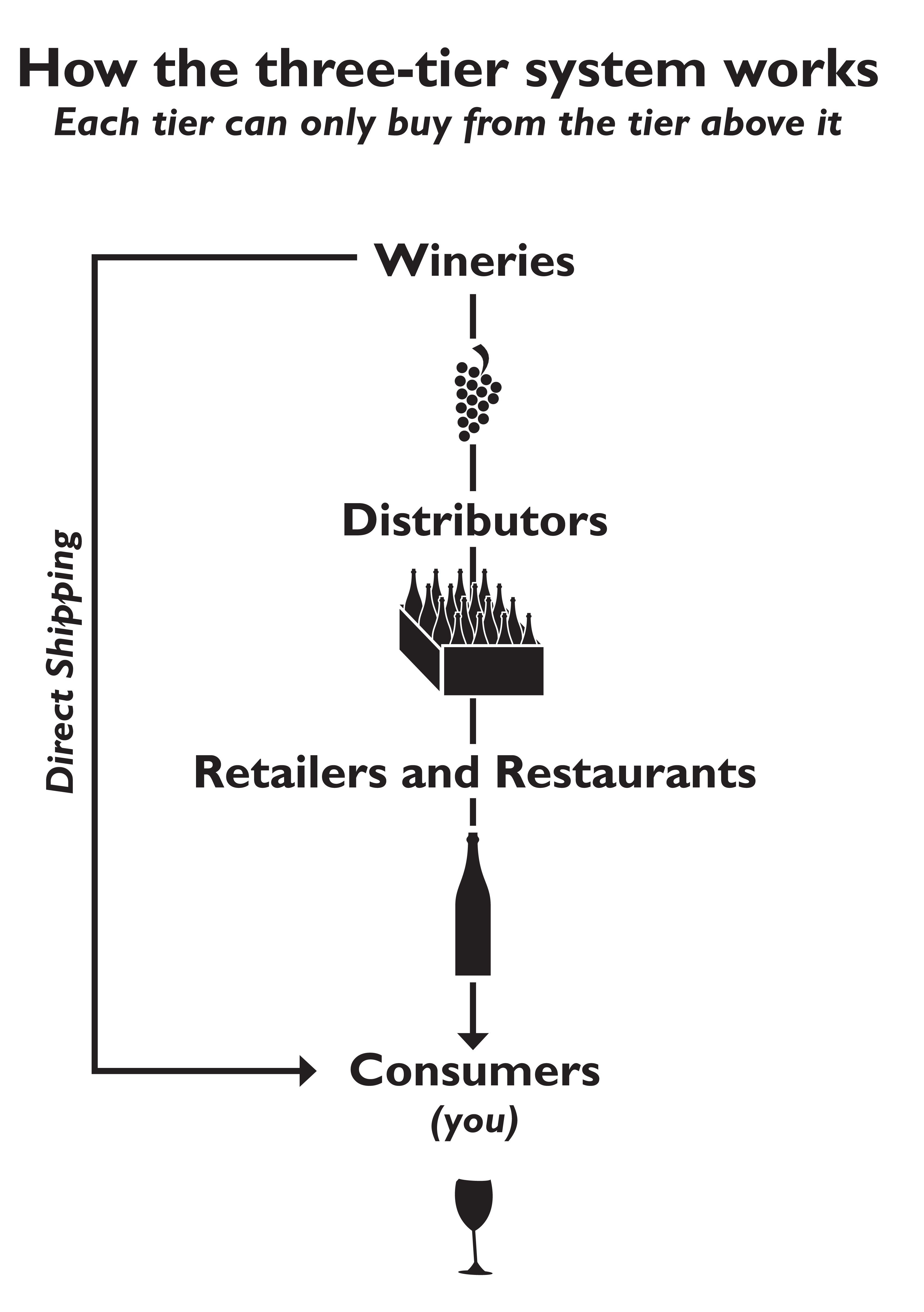
Prohibition, the 18th Amendment to the U.S. Constitution in 1920, outlawed the sale, manufacture, and transportation of alcohol in the U.S. until it was repealed 13 years later by the 21st Amendment. Repeal gave us the three-tier system, so named because it has three parts: The first tier are the producers, the wineries, breweries, and distilleries. They can only sell their product to a distributor, the second tier. Only the distributor can sell to retailers and restaurants, which are the third tier. Save for limited exceptions, like direct shipping, and which total less than 10 percent of all wine sales, the consumer can only buy wine from the retailer or restaurant.

This makes wine different from almost every other consumer good in the world. If you want to buy a computer from Dell or shoes from Nike, each is only a couple of mouse clicks away from the manufacturer’s website. And Amazon has become a $61 billion company by serving as the ultimate retailer, crossing state lines to sell its customers everything from books to underwear.

But ordering wine from an out-of-state producer is a crime in much of the U.S., and it’s a crime in every state to order wine from an out-of-state retailer. On-line retailers like Wine.com, which is in 42 states, have to legally qualify as an in-state retailer (by setting up an office or a warehouse, for example) to be allowed to do business in those states. And even Amazon, with its new Wine Marketplace, has to abide by these rules. Technically, it doesn ?t sell wine, but serves as a conduit to retailers and producers that are legally allowed to sell it.

How did we get to this point? Why is alcohol different from running shoes? Because the political compromise that ended Prohibition allowed each state to regulate alcohol in its own way. Three things are important about this:

? Every state ended up using some form of the three-tier system, and every state has modified the three-tier system to what it thinks works best for it. Which means there are 50 laws for 50 states, and sometimes different laws within states. Pennsylvanians can only buy wine from retailers owned and operated by the commonwealth. New Yorkers can’t buy wine in grocery stores. Montgomery County, Md., residents can’t buy wine at retailers like Cost Plus World Market, but residents of adjacent Prince George’s County can.

? Three-tier was designed to keep organized crime out of the booze business, which is understandable given the role organized crime played in bootlegging during Prohibition. Every liquor law attorney I have ever talked to says that ?s an important reason why three-tier has endured. State attorneys general and state liquor control boards, given three-tier ?s success in keeping the mob out of booze, don ?t see any reason get rid of it.

? The distributors, and especially those that deal in beer and spirits, don ?t want three-tier to change, and spend millions and millions of dollars annually lobbying state and federal legislators to preserve the system. This is understandable, too, given that the end of three-tier would mean the end of distribution as they know it. Their allies, surprisingly, are often independent retailers, who don ?t want their chain competitors to be able to buy wine directly from the winery, since that would give the bigger companies better pricing.

The worst part about thee-tier? We ?re stuck with it. A variety of federal court decisions, including Siesta Market in 2010, have said that three-tier is constitutionally protected, just like freedom of speech and freedom of religion. The 21st Amendment, say the various rulings, shelters three-tier from court challenges and state and federal legislation to alter it.

Yet none of this means three-tier is relevant in the 21st century. Prohibition ended 80 years ago, and organized crime has moved on. It ?s difficult to believe that rum running would be as profitable as today ?s pastimes, like credit card and bank fraud. In addition, we ?ve made tremendous strides in combatting alcoholism and drunk driving in the U.S., and these abuses are always given as a reason for three-tier.

For wine drinkers, three-tier limits consumer choice. Do you live in Illinois and had a wine you liked at dinner in Wisconsin? Did you try to buy that wine in Illinois only to find that it isn’t available? That’s the fault of three-tier. Just because a distributor in Wisconsin carries the wine is no guarantee that a distributor in Illinois will carry it. The Illinois distributor may not like the wine or the person who makes it or how much it costs. So they decide not to carry it, and you can’t buy it ? even though it’s available in another state just a half-hour drive away.

This is an especially acute problem for cheap wine. Distributors, all things being equal, prefer to deal with the biggest producers. They can get better pricing, the supply chain is more efficient, there is money for marketing, and they’ll have more wine to sell since big producers deal in tens of thousands of cases.

But much cheap wine ? perhaps the most interesting cheap wine ? is made by smaller companies that don’t produce tens of thousands of cases, can’t offer the best prices, have less efficient delivery systems, and whose wines are more quirky. So they have more difficulty finding a distributor ? and often can’t.

This is such a problem that there are trade events for wineries that don’t have distributors, held in the hope that a distributor will sample their wines and then take them on. It’s kind of sad, actually. Meanwhile, smaller wineries that do have distributors usually have to settle for smaller distributors that have less clout with retailers, which means the producer’s wines are limited in availability and may even cost more.

I ?m resigned to three-tier, given the court rulings. But that doesn ?t mean I have to be happy about it.

Winebits 288: Wine sales trends edition

? The three-tier system strikes again: How minor a role do on-line sales play in the U.S. wine marketplace? Pretty minor, according to a new French study. One in four Chinese wine sales use the Internet, while as many as one in 10 in Europe are done on-line. In the U.S.? Just two percent, and in one of the more masterly of recent understatements, the study ?s author cited ?legislative constraints ? as the reason. In other words, it ?s mostly illegal in this country, thanks to three-tier and the system that has evolved in the U.S. since the end of Prohibition.

? The Federal Reserve and wine sales: This post, from Silicon Valley Bank ?s Rob McMillan, explains (in English, too!) what ?s going to happen to wine sales now that the Federal Reserve is going to do less to stimulate the economy. The technical term is quantitative easing, and since we ?re going to see less of it, McMillan predicts a stronger U.S. dollar and higher lending costs for wineries who want to expand or make acquisitions. The former is good news for the consumer, since it should lower the cost of imports and keep wine cheap. It may also be bad news for high-end producers, who have higher costs of production and need higher prices to stay in business. And that interest rates will go up probably isn ?t good news for them, either. This post shows why McMillan is one of the really smart people in the wine business, and he deserves to win the Wine Blogging Award for best industry/business blog next year.

? Beware the hype: Steve McIntosh at Winethropology warns us that many of the lower prices we ?re seeing these days have very little do with wine quality and a lot to do with retailers and distributors getting rid of wine that is ?occupying precious warehouse space ? not all of which is worth your hard-earned money – at any price. ? He says he fell for the hype and bought two bottles recently, One of which is nothing more than ?a watered down version of wine. ?

Winebits 281: Wine glasses, direct shipping, Italian wine

? Brushes for sale: There are three intriguing things about this post at Forbes about cleaning wine glasses. First, that Forbes would mess with it, given that it doesn ?t seem like something their high-dollar readers would worry about. Don ?t they have someone to clean their glasses for them? Second, that the best solution costs $4, using a baby bottle brush. This reinforces the Wine Curmudgeon ?s theory that most wine accessories aren ?t worth the money they cost and would be better spent on wine. Third, that the baby bottle brush company could have cared less about this new us, which points to the insignificance of the wine glass market in the greater scheme of things. Tip ?o the Curmudgeon ?s fedora to the great W.R. Tish, who sent this my way.

? Impressive numbers? The Wine Spectator analyzes the latest sales gains for winery to consumer shipping in the U.S. in such a breathless fashion that even I was impressed. And, given the legal restrictions, the almost $1.5 billion in sales is impressive (and that regional wine does more direct shipping than Washington and Oregon was pretty amazing). The catch, though, is that the $1.5 billion was just 4.4 percent of the total wine market. Until we see serious reform in three-tier, which hardly anyone is optimistic about happening anytime ever, direct shipping looks to remain a tiny, if lucrative, part of the wine business.

? Italian sales woes: Not in the rest of the world, where a leading Italian producer saw exports salvage its 2012 sales figures. Frescobaldi reported a 3 percent increase last year, despite a 5.1 percent decline in domestic sales. Once again, for everyone writing about wine, prices are a function of supply and demand. If demand decreases, as it has in western Europe over the past two years thanks to the euro crisis, then there must be a matching decrease in supply to raise prices.

Winebits 277: Direct shipping edition

? New York decision: There is a lot of legalese in this blog post from the California firm of Dickenson, Peatman & Fogarty, but the gist is that New York state ? based on a recent liquor authority ruling ? will apparently make it harder for third parties, like Amazon, to participate in Internet wine sales. Specifically, says the post, the New York decision (which we ?ve discussed here) and a 2011 California liquor board ruling aren ?t consistent in several important areas. This is crucial, since Amazon is basing its business model on the California ruling. I ?ve been told by my liquor law sources that what happened in New York is not surprising and that there are still many unknowns as Amazon tries to expand into the two-thirds of the country where it doesn ?t do business.

? Welcome to Texas: Amazon, on the other hand, scored a victory here when it announced five Texas wineries will participate in its wine marketplace. The Texas liquor board decision to allow Amazon into the state was a close run thing, I was told, but the result is that consumers in the 15 other states (plus the District of Columbia) that Amazon serves will be able to buy some very nice wine. If you need any recommendations, click on the blog ?s Texas wine category link. Also worth noting: I talked to several Texas winemakers, and they said Amazon sent employees to the state to taste wines before launching the program. Now there ?s a job ? wine scout for Amazon.

? Who needs Amazon? Not the British, where two entrepreneurs have a plan to let retailers sell excess inventory on the Internet. GrapePip.com, reports the Harpers trade magazine, was set up by Caspar and Victoria Bowes, who run fine wine merchant Bowes Wine. Their goal is to sell almost $400,000 worth of wine in their first year, using an eBay-style auction system.