



Category:Wine trends

Six things the wine business is doing to cut costs and drum up business during the duration

wine business
“Hmmm. How can I write about the same wine this year that I wrote about last year?”

It hasn’t been easy for wine producers, marketers, and PR types during the pandemic

Yes, we’re buying more wine over the Internet than ever before, but that doesn’t mean the wine business is healthy. Ask anyone at the biggest distributors who was laid off in the past eight weeks. So how else is the wine business cutting costs and drumming up business during the duration?

This is what I have seen:

• Using Styrofoam inserts for packing wine samples. I really haven’t seen any in a couple of years, given Styrofoam’s environmental evil. Most shippers have switched to cardboard liners or plastic bubble bags. But during the duration, Styrofoam appeared again, since it was probably sitting in a back room and has already been paid for.

• Samples from producers who wouldn’t normally speak to me, let alone send me wine. I’m not the only who has had this happen; several of my colleagues have reported the same thing. Said one: “What am I going to do, writing about heavy Napa cabernet, in the middle of summer?”

• Old samples, as in the same samples I got last year. I’ve never had this happen before, but one producer sent me the same rose they sent in 2019. This speaks to how much wine is sitting in warehouses, unsold and unloved.

• Emails every two or three months offering me the same wines they just sent me. This has happened two or three times this year, where a PR firm offered me wine at the end of last year and the same wine a couple of months later. And then a couple of months later.  Once again, this speaks to how much wine is sitting in warehouses, unsold and unloved.

• Virtual tastings, where I have to try and find the wine to taste with the producer. I don’t mind buying the wine, since I do so much of that anyway. But what’s the point of inviting me to a virtual tasting when I can’t find the wine to taste?

• Pleas for money. I’ve never seen this. Ever. But I one email I got from a wine trade association asked to help them find money to expand their marketing efforts during the duration. We’ll ignore the fact that my job isn’t to help them sell wine, but doesn’t asking for money from complete strangers smack of quiet desperation (to paraphrase Henry David Thoreau)?

Winecast 46: Richard Hemming, MW, and why wine writing isn’t necessarily objective

richard hemming
Richard Hemming, MW

“Why should [consumers] trust us? They shouldn’t, necessarily,” says Singapore-based wine writer

Richard Hemming, MW, a Singapore-based wine writer, wrote one of the most amazing blog posts I’ve ever read: Wine writers can’t be objective given the incestuous nature of the wine business, and consumers need to know that this prevents us from always being objective.

It’s one thing for me to write that, which I’ve been doing as long as there has been a blog. But if Hemming, firmly part of the Winestream Media — initials after his name, consulting work, and articles for important magazines and websites — writes this, it speaks to how messed up wine writing is.

Hemming doesn’t disagree. But he also doesn’t see a solution, since it’s difficult to make a living as a wine writer. So we have to depend on the kindness of strangers, with all of the compromises that entails. In this, Hemming notes, there’s a difference between a compromise, like not writing something that would offend a source, and corruption, such as taking money for a positive review.

Needless to say, I don’t agree. But Hemming’s point is well taken, and he hits on one of the key questions facing post-modern journalism, wine or otherwise: What’s going to replace the ad-supported model that paid for newspaper and magazine reporting in the second half of the 20th century? Because, so far, it isn’t the Internet.

The other thing worth noting? The post was easily the best read on Hemming’s blog, and most of the comments — from wine writers, of course — agreed with him.

Click here to download or stream the podcast, which is about 15 1/2 minutes long and takes up 9 megabytes. Quality is good to very good; I still haven’t figured out how to get the most out of Zoom.

Seven reasons to celebrate rose for the blog’s 13th annual pink wine extravaganza

rose wineThe world – and wine – may be increasingly complicated, but we still have rose to chill, sip and enjoy
The blog celebrates its 13th annual Memorial Day and rose extravaganza this week. That means 15 or so rose reviews over three days, starting Wednesday, as well as a giveaway on Thursday. Wine glasses, anyone?

So here are seven reasons to revel in all the glory that is pink wine:

• It’s still mostly cheap and well made. I wrote this in my early rose posts, when only cranky ex-newspapermen and assorted wine types liked rose. And, despite its popularity, $10 will still buy a terrific rose. How many other kinds of wine can we say that about?

• Producers large and small may be tarting up chardonnay and red blends, but they’ve mostly left rose alone. Yes, some so-called “dry” rose is as sweet as a lot of sweet reds. But this isn’t widespread, and it hasn’t turned into the scourge I once feared.

• Even canned rose can taste like rose. Too much canned wine is made so it can be sold in a can, and quality is secondary. But more canned rose than you would think tastes just as it should – dry, crisp, and fresh.

• It’s widely available, whether you shop online, at a local retailer, or in a supermarket. That we can buy quality rose from the supermarket Great Wall of Wine gives me hope that wine may not be doomed.

• Big Wine makes great $10 rose. Thank you, wine gods (and Big Wine marketing types for staying out of the way).

• Almost every wine region in the world produces affordable, quality rose. How many other kinds of wine can we say that about? We might want to avoid Spanish chardonnay at all costs, but Spanish rose is among the best there is.

• Rose unites wine snobs with people who think rose was invented about the same time as Instagram. Would that more things in wine were able to do that.

Radio wine ad: Stiller & Meara for Blue Nun

Stiller & Meara’s radio wine ad helped sell millions of cases of Blue Nun

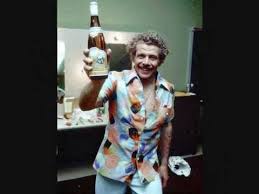
In one respect, this 1970s Stiller & Meara radio wine ad for Blue Nun is nothing more than Ed Sullivan show-style stand-up comic corniness, complete with bad puns and worse one-liners. “How did I know you’re a stranger?” asks Anne Meara. Answers Jerry Stiller, not missing a beat despite the fact that the joke is probably as old as jokes get: “That’s right, Elliot Stranger.”

So why does the ad work?

Because it doesn’t make wine something that it’s not, like almost every wine ad we’ve looked at on the blog. It’s not snotty and it’s not about beautiful people being beautiful, the two most common faults of wine advertising. Rather, it focuses on two seemingly ordinary people, one of whom wants to buy wine for a dinner party. So why not buy Blue Nun, “the delicious white wine that’s correct with any dish”?

In the end, isn’t that what we’re all looking for, whether wine-guzzling Baby Boomer or hard seltzer drinking Millennial? Doesn’t everyone want something enjoyable to drink with dinner without any fuss and bother? Instead, we get snobby art openings and double entendre kangaroos.

The ads were a smash hit, costing just $70,000 (not even a lot of money in those long ago days), and helped Blue Nun sell 2 million cases a year in the U.S. by the mid-1980s. They also gave Stiller, who died this week at 92, something to do between the end of the duo’s performing days and his cranky TV supporting parts on “Seinfeld” and “King of Queens.” Meara, his wife of 61 years, died in 2015 at the age of 85.

Ironically, despite the success of the radio ads, much of the rest of Blue Nun’s advertising is just as ordinary as the rest of wine’s efforts. Which isn’t all that surprising, is it?

Ad courtesy of musicalcliff via YouTube, using a Creative Commons license

Winecast 45: DCanter’s Michael Warner and wine retail trends during the duration

Michael Warner
Michael Warner of DCanter

Our wine purchases during the duration? Cheap and cheerful, says this Washington, D.C. retailer

Michael Warner, the co-founder of DCanter, a neighborhood wine shop in Washington, D.C.’s Capitol Hill neighborhood, has seen all the reports about wine buying during the duration: More expensive wine to treat ourselves, lots of this and some of that, and even boxed wine. But he thinks he has seen something significant at this shop, which has more affluent demographics than most.

“Cheap and cheerful,” says Warner, whose store is seven years old. “People are buying less expensive wine. They’re not entertaining, which is when they would buy more expensive wine.”

In this, he says, his customers are buying more vinho verde, the cheap Portuguese fizzy wine, as well as half bottles. That’s because those who live alone want wine for dinner, but don’t want to waste it, and that’s what half bottles are for.

We also talked about:

• That wine delivery and Internet sales have become as important as the studies suggest. Dcanter sold more wine on-line in the first two days of D.C.’s stay at home order than it did in the previous three years.

• The need to update delivery and on-line ordering regulations to reflect the 21st century. DCanter’s customers who live in Maryland,  just a couple of miles away, can’t get delivery. But those in Virginia, also a couple of miles away, can. How much sense does that make?

• The obstructions in the wine supply chain thanks to the pandemic, and that it is becoming more difficult to find imported wine.

• Wine retail websites, and how too many of them look and work like they were put up during GeoCities’ heyday.

Click here to download or stream the podcast, which is about 11 minutes long and takes up 4 1/2 megabytes and was recorded on Skype, the blog’s unofficial podcast software.

60 days in: Your favorite WC posts during the duration

favorite
No doubt more of us would wear masks if we all looked this stylish.

You’re looking for wine advice, crappy wine TV ads, and Barefoot wine (still)

Blog traffic has evened out since the coronavirus pandemic hit the U.S., and we’re back to more or less normal daily numbers. The intriguing thing? Traffic was approaching holiday season levels for the first couple of weeks of April. I’m guessing people wanted to find quality cheap wine to stock up on, and what better place to find those wines than here?

Cue GIF of WC patting himself on the back.

The good news is that the pandemic outlook seems to be better. But that doesn’t mean we should be any less careful.  So stay home unless you need to go out (and no, the mall food court isn’t a necessity), wash your hands, and keep out of sneezing range when you go to the supermarket.

Your favorite posts during past 60 days:

• Ask the WC 1: I figured out why this seven-year-old post has been so popular — cava recommendations. You wanted to stock up on good, cheap bubbly, and why not?

• The Kim Crawford TV ad: I’m not the only who dislikes it, and that dislike has been shared by increasing numbers of visitors.

• Residual sugar in wine: Note to wine business: Wine drinkers want to know how sweet you’re making their wine. So why not be honest with us?

• Changes in the three-tier system after the pandemic: How do I know this post has made an impact? Because I lost a dozen or so email subscriptions in the couple of days after it ran, always a sure sign I annoyed someone.

• Barefoot wine, three times: Because Google. In those deep, dark nights when I grow despondent about the future of wine, I think about the time and effort I put into the blog, and that it doesn’t matter because Google sends people to these three posts. And then I get even more despondent.

• The wine bottle workout: Because Google, again. This was a bit of humor that no one paid much attention to when it ran almost three years ago. But if you’re stuck at home and start searching for “workout,” I guess it shows up.

• The Grocery Outlet cheap wine story: Note to wine business: We want to find retailers who sell quality cheap wine. So make some for them to sell.

• The Mafia winery story: Just wish there was a way to update this, short of repeating denials from the winery’s corporate headquarters.

What’s missing? The do-it-yourself “Wine during the duration” post. It’s pretty damn funny.

Photo (and mask): Lynne Kleinpeter, using a Creative Commons license

Texas restaurants and alcohol to go

alcohol to goNew state alcohol to go law has helped restaurants stay in business, and the change may be permanent

Shawn Virene, who owns the Houston restaurant a’Bouzy, doesn’t mince words.

“Hopefully, this will keep going for a while,” says Virene. “It’s really helped us with our cash flow during all of this. It has allowed us to pair wine with food and sell it at a reasonable price.”

The “it” Virene is talking about? The decision to allow Texas restaurants to sell alcohol to go during the coronavirus pandemic. a’Bouzy sells out its daily takeout specials – dinner for two, plus a bottle of wine for the cost of the wine in most restaurants. The wine specials, plus selling margarita setups, he says, has allowed him to hang on during the pandemic-caused restaurant closure in Texas.

And he may get his wish about the rule changes lasting longer than the duration. Texas Gov. Greg Abbot, a Republican, tweeted this week that “Alcohol-to-go sales can continue after May 1,” when Texas lifted its statewide stay at home order. Wrote the governor: “From what I hear from Texans, we may just let this keep on going forever.”

As Virene noted when we talked this week, the changes are as welcome as they are unprecedented. Texas does not allow restaurants to sell wine or spirits to go; the very idea is regarded as blasphemous, and even BYOB is heavily restricted. Meanwhile, the state’s open container law is written so that those of us who legally take an unfinished bottle of restaurant wine home could still be arrested.

So we truly are in a brave new world, as I noted in last month’s three-tier post.

The reason for the change? Because it boosts business, and easier access to alcohol, so far, does not seem to have made anything worse. Virene makes 100 to-go dinners daily, and he sells out by early afternoon. At his prices, that’s understandable. The most expensive dinner, crab-stuffed flounder for two, costs $69, and that includes a bottle of Champagne. Most are $44 or less, including coq a vin plus California merlot for $44; lasagna and Chianti for $32; and Taco Tuesday with Rioja for $39. The margarita setup, enough for a half-gallon with Jimador Tequila Silver, costs $32.

Virene says he can afford to do that because he doesn’t mark his wine up 3 to 4 times the wholesale price, which is standard restaurant practice. Rather, his markup is less than 2 to 1, because “I would rather sell you two or three bottles and know you had a good time, instead of selling you one bottle and know you went home thinking you had been ripped off.”

That’s the Wine Curmudgeon’s approach to restaurant wine. In this, Virene says other Houston restaurants seem to be adapting his to-go policy, thanks to the changes in the law. Maybe they will adapt his pricing policy, too.